In the player's hands Signal 004
What you carry has consequences
Hands, pockets, and unfamiliar objects give Chimera's inventory physical consequences—and give discovery somewhere to live.
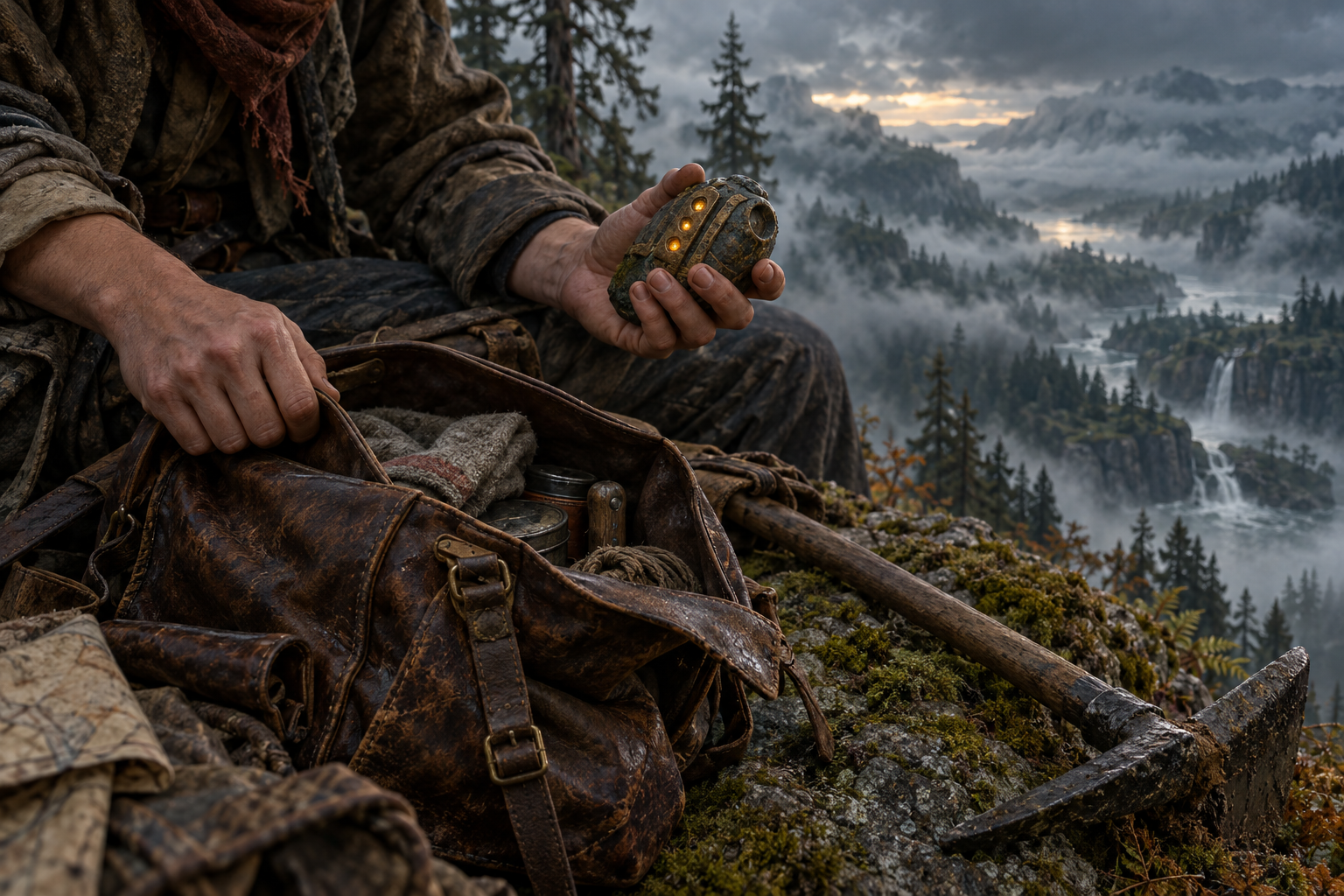
Imagine finding a small, unfamiliar object beside the trail. It fits in one hand. A few marks on its surface catch the light. You want to take it with you.
But that hand is already holding something.
This is the scale at which Chimera's world begins to push back. The planet can be enormous, yet a useful decision may come down to a pocket, a tool, and the space between your fingers.
The recent inventory work gives those decisions a physical basis. Objects have placements, containers have limits, and learning what something does is a different action from picking it up.
A place for everything you take
Picking up an object puts it in an available hand. It does not silently find a home in a bag. Storing it is another deliberate action, with a particular compartment as the destination.
That compartment has constraints. Weight matters, but so do usable volume, opening size, and the size of the object itself. A small heavy object and a long light one can fail to fit for different reasons. The engine uses conservative capacity checks rather than trying to simulate every possible arrangement inside a bag.
Equipment can also occupy supported body positions. A tool may hang from the back while traveling, then require both hands when used. If something is already occupying a needed grip, the player must make room.
These rules give ordinary verbs consequences. Take, hold, stow, ready, and drop describe distinct changes to the world.
Leaving something behind is a real action
A dropped object remains at the player's location in persistent state. Dropping a container preserves the things inside it. Their weight no longer belongs to the traveler, but their existence does not end at the edge of the inventory listing.
Gathering follows the same principle. Extracting a resource produces material on the ground; collecting it is a separate step. Successfully obtaining something does not imply that you have the hands or capacity to carry it away.
The language model can interpret the request and describe the result. The simulation checks the placement and commits the change. A persuasive sentence cannot make a full compartment larger.
Looking is not pressing the button
An unfamiliar object creates another kind of constraint: the player may possess it without understanding it.
Chimera separates examination from operation. Looking at a visible feature reports what the character can perceive. It does not activate a control merely because the underlying object has one.
A readout might initially be described through physical observations—several marks are lit—without revealing the hidden name of the mechanism or what its numbers mean. After an operation and a subsequent examination, the character can acquire evidence connecting the display to the behavior they observed.
That distinction lets curiosity develop through actions. The engine already knows the object's mechanics; the character earns an interpretation of them. The narrator receives the character's permitted evidence.
Recognition travels with you
Learning is also broader than one particular object. Experience with an item can contribute to recognition of its kind, so finding another of the same design does not force the character to begin again from complete ignorance.
The second object still has its own condition and state. Recognizing the design does not tell you how much energy this instance has left, or what has happened to it since it was made.
This is an early implementation. It does not make every imagined use of an object executable, and it does not yet provide general teaching or reading mechanics. It establishes the boundary those systems will need: an object can have a stable physical truth while different people understand it differently.
The traveler can finally put the unfamiliar object away. The pocket now carries its weight. The character carries what they learned.
Both should still be there when the journey resumes.